
Before Loosewire could find his way across the city, he had to find his feet in the sand.
One loop forward. One loop tangled.
He landed with a small puff and looked down at the wire responsible.
Patcher sat nearby, a blue spade resting against her knee.
“Useful discovery,” she said.
“I was going for walking.”
“We can try that next.”
A place for beginnings
This is The Sandbox. Grains of ideas gather into little paths, half-built bridges, and ambitious sandcastles. New software pieces discovering the jobs they might one day do.
An envelope courier practices carrying a pebble. Tiny workers sort parts into shallow bowls. Gizmo discovers that going down a slope is easier than stopping at the bottom.
Here, ideas take shape as early versions of themselves. Familiar characters can have small beginnings. Helpers give them room to try, notice, and try again.

An early version does not need to do everything. It needs a useful next question.
The real idea behind the sand
In computing, a sandbox is a controlled environment where software can run with limits on what it can access or affect. Those limits may cover files, network connections, credentials, or computing resources.
Developers try new code here. Testers explore awkward cases. Learners practice with unfamiliar tools. AI workers can carry out tasks with deliberately limited access. Security specialists use environments designed for the risks they are examining.
Our world imagines that early development as childhood. In real software, builders make changes between attempts; ordinary programs do not automatically learn from their mistakes.
A little bridge, a useful question
Jumper has found a narrow channel in the sand. On the other side: a flat wooden block. On this side: a courier, one blue pebble, and considerable expectation.
He places one connector foot. Then the other.
Can this connection carry what needs to cross?
The courier edges closer. Jumper adjusts his stance. Nearby workers keep trying their own small tasks. The Sandbox is busy with beginnings, each different enough to need its own experiment.
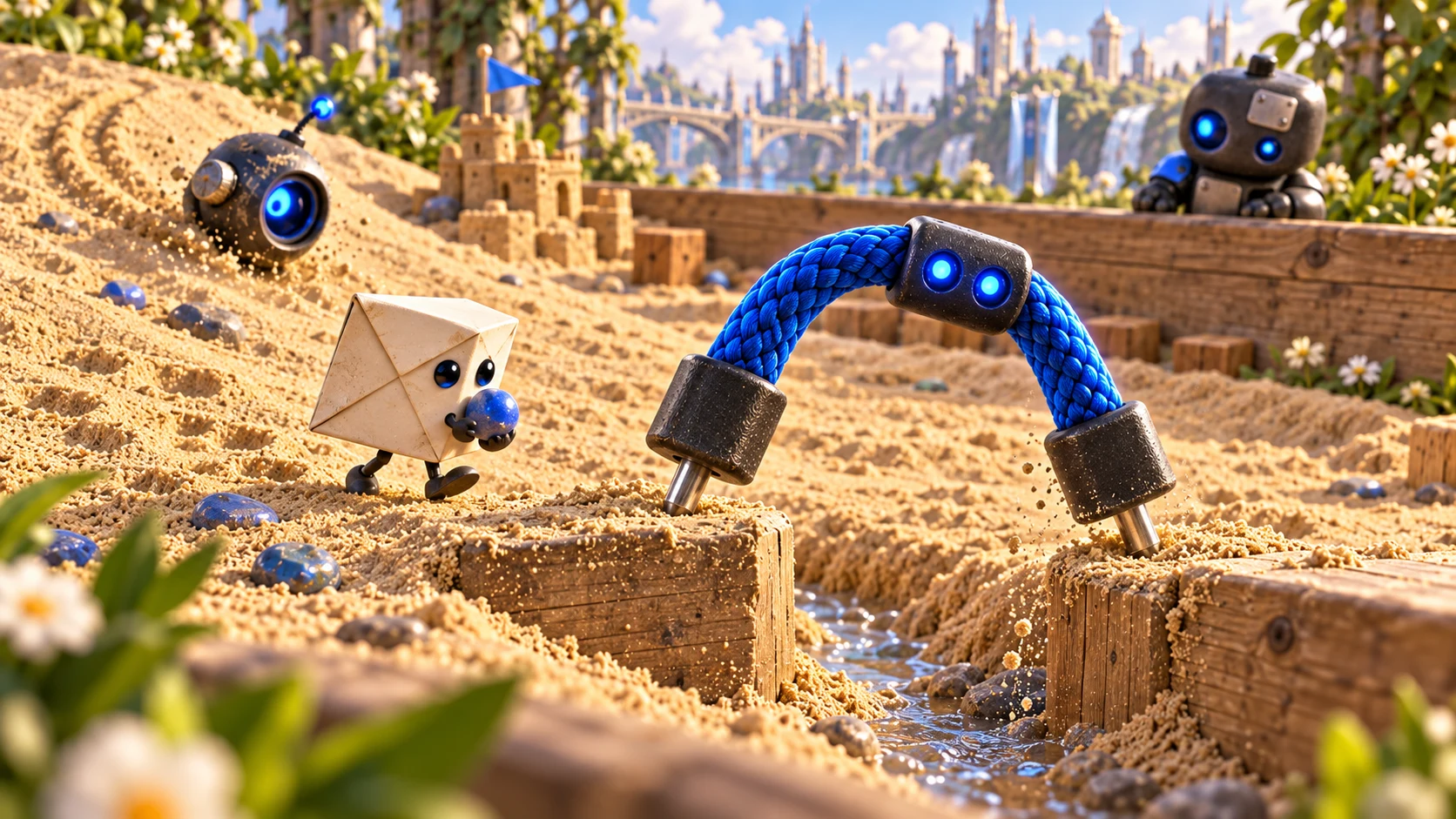
A connection is something to test. Its existence does not tell us what it can carry.
Where do sandboxes exist?
One may run on a laptop, in a virtual machine, in a suitably configured container, or in a cloud test environment. A service may provide its own sandbox: a payment provider, for example, can let developers simulate purchases without moving real money.
These arrangements have different boundaries. Containers commonly share the host’s operating-system kernel. Virtual machines usually run a separate guest kernel. The name alone does not tell you whether the setup fits your experiment.
People use sandboxes before an unfamiliar change reaches something they depend on. They return when an idea changes, gains new permissions, or needs another kind of test. Grown-up software still has reasons to visit.
Small mistakes need somewhere to land
Gizmo nudges a pebble toward a little sand bridge.
The pebble is rather large. The bridge is rather optimistic.
There is a soft collapse.
Patcher brings the spade. First they look at what happened. Then they reshape the arch. The next attempt will answer a slightly better question.
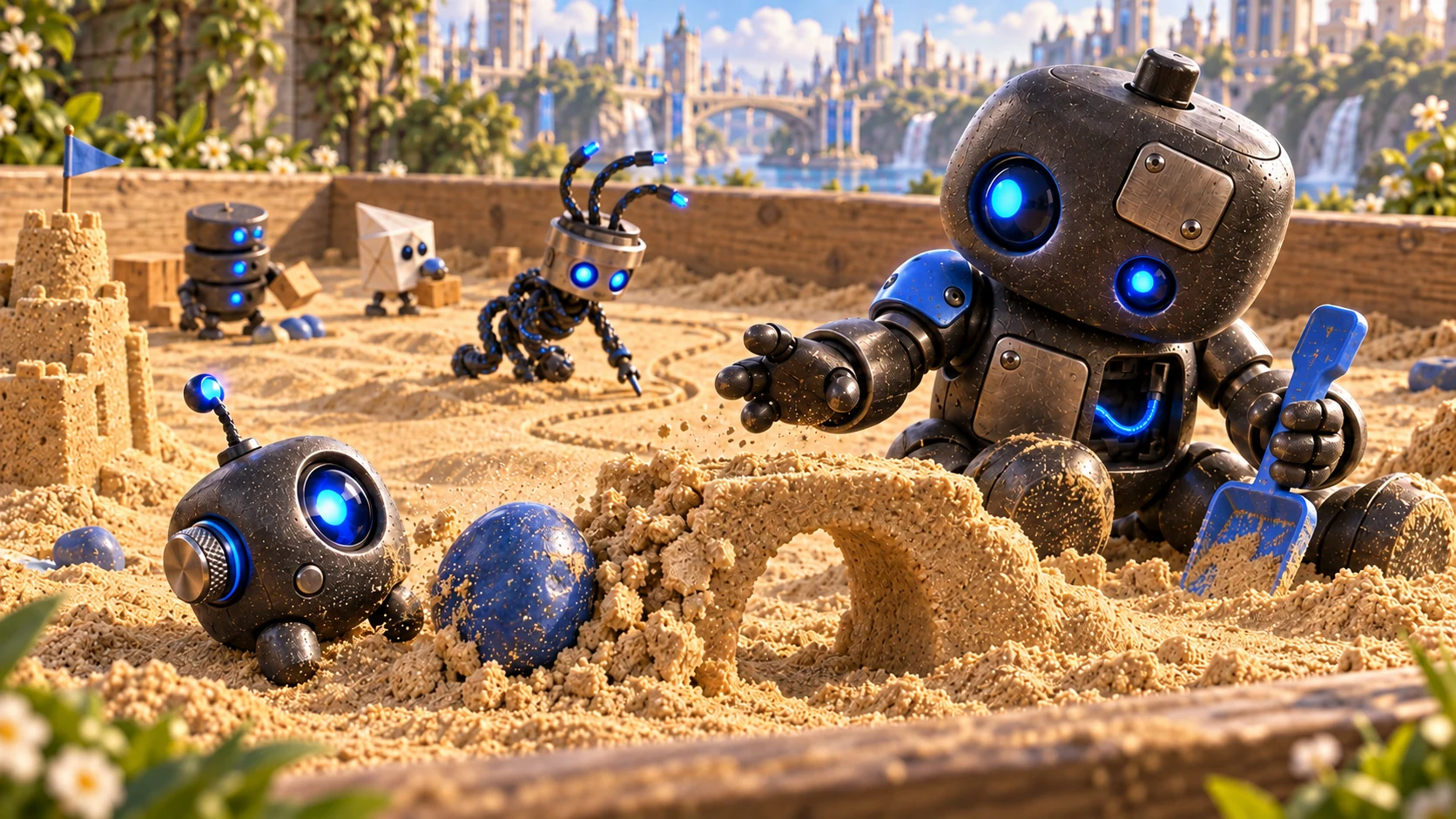
Notice the result before changing the experiment.
In a real sandbox, agree on the job, the test data, the allowed connections, the resource limits, and the way to stop and reset. Use made-up or approved test data where possible. Time, memory, processing, and spending limits need appropriate configuration.
Our wooden perimeter makes boundaries visible. A computer needs actual controls. A shared folder or network connection can reach outside the test space. Resetting it may remove local changes without undoing something already sent elsewhere.
Ready for the wider world?
Loosewire tries his next step. This time, the loose loop clears his foot.
Patcher notices. So does he.
One useful result. Another question waiting.
That is why The Sandbox belongs in our world: somewhere an unfinished idea can begin, find its shape, and become better understood.
There is still a little room in the sand.
Look over the edge
A practice program can write to your real Documents folder. Is everything it changes contained in its disposable test space?
See the answer
No—the shared folder crosses that boundary. Changes there can affect the host. Give an experiment a separate test folder and the access it actually needs.
Field notes
- NIST: sandbox definition
- Microsoft: Windows Sandbox configuration and shared folders
- Docker: container security and isolation
- Stripe: payment sandboxes
Fictional characters, real concepts. The Sandbox’s young inhabitants represent early software versions; not all software begins in a sandbox. Inspired by our work on node01. Illustrations were created with AI assistance.